About
Mallorca is the largest of the Balearic Islands — 3,640 km² in area, 920 thousand inhabitants, and more than 12 million tourists per year. These numbers can give the wrong impression: one thinks of drunken British teenagers on the beaches of Magaluf or the joke of Germany's 17th state. That face of Mallorca is real, but only a part of it. The real story of the island is elsewhere: the olive terraces of the Tramuntana mountains, the ocher houses of Deià, the steep cliffs of Cap de Formentor and the turquoise waters of Es Trenc that resemble the Caribbean.
We can say that there are two Mallorcas. First southwest coast of Mallorca — Magaluf, Palmanova, Santa Ponsa. All-inclusive hotel complexes, neon bars, foam parties. An overseas extension for British holidaymakers "to avoid feeling like they've left home"; Germany also does the same work around Playa de Palma (Bierstrasse legend). Second Mallorca — northwest coast and inner island — UNESCO World Heritage mountain range, century-old farmhouses, boutique winemakers, Chopin's monastery, Robert Graves' tomb. On the same island, 50 km apart.
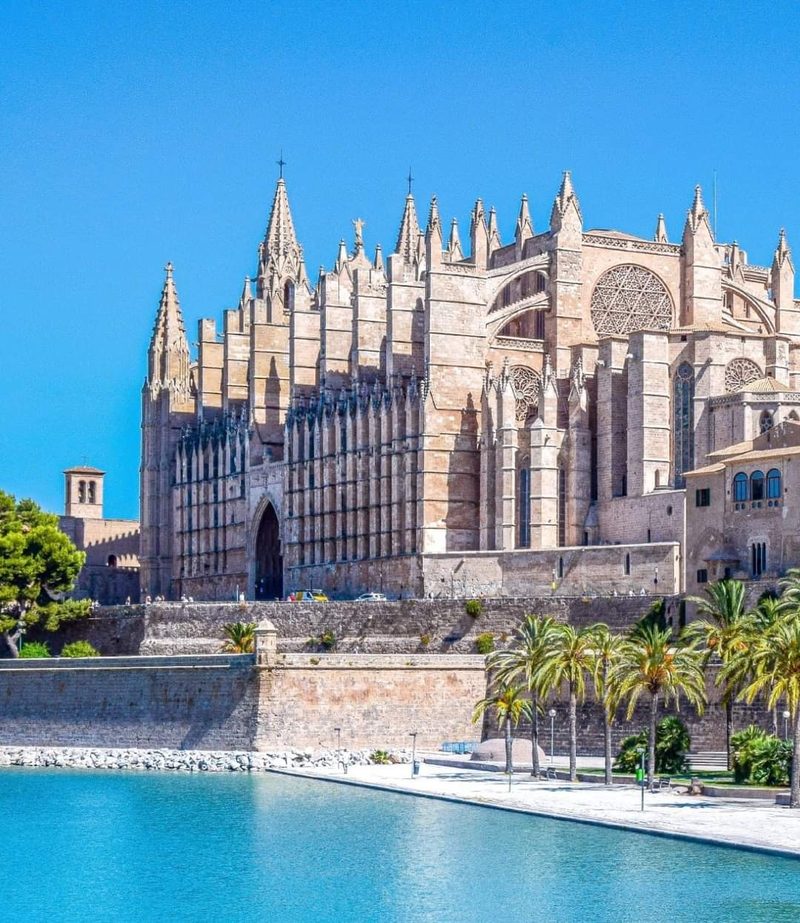
The capital of Palma de Mallorca is about 420 thousand people. The Gothic cathedral La Seu is erected by the sea, Gaudí revised the interior design at the beginning of the 20th century. The old town has a different Mediterranean character than Seville, Granada and Barcelona — quieter, less touristy, more casual. You can try one of the most expensive clubs in the world with an entrance fee of 60 EUR for one night in Pacha Palma, then go to Magaluf the next day and spend the same night for 15 EUR — experiencing this contrast once means understanding Mallorca.
On the food side, Mallorquí cuisine combines land and sea. Sobrasada (soft sausage with paprika - the most popular product of the island), tumbet (potato-eggplant-tomato casserole), frit mallorquí (pan with offal), pa amb oli (tomato bread with olive oil), caldereta de langosta (lobster casserole, the centerpiece of the luxury table) are the classics. Ensaimada — a spiral-shaped brioche layered with lard — is Mallorca's signature dessert, and everyone grabs their box and boards the plane. Hierbas liqueur (anise + mountain herbs) is drunk as an after-dinner ritual, neat or with ice.
When to Go
Mallorca has a typical Mediterranean climate — mild winters, hot summers. Smart tourists choose mid-season.
| Period | Weather (daytime) | Sea | Density | Otel Fiyatı | Notes |
|---|---|---|---|---|---|
| January-February | 8 / 16° | 14° | Low | Low | Many tourist hotels are closed; Atmosphere of Sant Sebastià (January) |
| March | 10 / 18° | 15° | Low | Low | Spring is opening, cyclists are coming |
| April | 12 / 21° | 16° | Medium | Medium | Blooming almond trees, ideal hiking season |
| May | 15 / 24° | 18° | Medium-High | Medium-High | The most beautiful month — the sea is a little cool but everything is in bloom |
| June | 18 / 28° | 21° | High | High | Summer is starting, the sea is getting warmer, the crowd is increasing |
| July | 21 / 31° | 24° | Very High | Very High | Holiday peak; hotel is difficult, beaches are full |
| August | 22 / 32° | 25° | Very High | Very High | The hottest and most crowded; inner island can see 38°C |
| September | 19 / 28° | 24° | High | High | The sea is still warm, the crowds are thinning — the best choice |
| October | 16 / 24° | 22° | Medium | Medium | Autumn harvest festivals, swimming until mid-October |
| November | 12 / 19° | 19° | Low | Low | The rainy season begins, sea temperature drops |
| December | 9 / 16° | 16° | Low | Low | Christmas markets, exploring tranquil Palma |
Our general recommendation is May-June and September-October. May is for flower fields, September-October is for a holiday without crowds while the sea is still warm. If you are going to go in July-August — you will, because it is a school holiday with kids — make your hotel and car reservations 4-6 months in advance, prices will be at their highest. The January Sant Sebastià festival is a special experience for those who want to see the real character of Mallorca — but some coastal hotels are closed in winter, so you have to stay in Palma.
How to get there
Mallorca's only airport, Palma de Mallorca Airport (PMI), is 8 km east of the center of Palma. One of the busiest airports in the Mediterranean — one takeoff and landing every minute during the summer months.
Flights from Türkiye:
There are no direct flights to Mallorca from Türkiye. Mandatory transfer:
| Exit | Transfer | Duration | Airline |
|---|---|---|---|
| Istanbul (IST) - PMI | Madrid (MAD) | 6-8 hours | Iberia + THY |
| Istanbul (IST) - PMI | Barcelona (BCN) | 5-7 hours | Vueling + THY |
| Istanbul (IST) - PMI | Frankfurt / Munich | 7-9 hours | Lufthansa + THY |
| Istanbul (SAW) - PMI | Rome / Milan | 7-10 hours | Pegasus + ITA Airways |
The most reasonable route is Istanbul → Barcelona → Palma. The flight from Barcelona to Palma is 50 minutes, Vueling offers 10+ flights per day, prices are 40-80 EUR. Total ticket average is between 280-380 EUR. Prices exceed 500 EUR during the summer high season — buy early.
Alternative: Some tour operators offer Istanbul-Palma charter flights between May and October. It can be more affordable if you come as part of a holiday package.
From airport to city:
- A1 Bus: 25-30 min, Plaça d'Espanya (Palma centre), 5 EUR. The most practical. 24 hour service.
- A2 Bus: Playa de Palma + S'Arenal beaches — budget hotels on this line.
- Taxi: 20-25 min, 25-30 EUR flat rate to Palma centre.
- Car Rental: All major companies within the airport (Hertz, Avis, Europcar, Sixt). 40-60 EUR per day in summer season, 20-30 EUR in winter. Condition — it is very difficult to visit the island without a vehicle.
Urban Transportation
For Mallorca, we need to talk about "intra-island transportation" rather than "urban transportation". Palma is compact and walkable, but a car is required for the Tramuntana, Es Trenc, Drach caves.
Car rental: Let's even say it again — a must for an island trip. You visited one village by public transportation, and when you went to the second one, it took half a day. In summer 45-65 EUR per day (small segment), compact 60-80 EUR. Early booking gets a 30-40% discount. Parking costs 5-10 EUR per day on some beaches; Paid blue zones are common in village squares (1.20-1.80 EUR per hour).
Bus (TIB): There is a bus network throughout the island, but it is sparse. From Palma it is reasonable to reach centers such as Sóller, Valldemossa, Pollença, Andratx; but it dries up on beaches and villages. Single ticket 3-7 EUR depending on distance.
Train: Palma - Inca - Manacor / Sa Pobla lines. Sóller train is a separate category (touristic and historical). Limited for active use.
Historical Tram: Sóller-Port de Sóller line from 1913, with open wagons. It's more of a touristic experience than practical transportation.
EMT (Palma urban): City buses are common. Single ticket 2 EUR, 10-pack card 9 EUR. Prefer walking within Palma — the center is around 1 km², you should walk.
Cycling: Mallorca is one of the cycling paradises of the world — the Tramuntana roads are the winter camp of professional teams. If you are a hobby rider, recommend the flat south (around Es Trenc), the mountains are too much for the inexperienced rider.
Accommodation Regions
In Mallorca, the choice of location determines the type of holiday. Don't make bad choices:
- Palma (center): City enjoyment, restaurants, museums, nightlife. The beach is far (5 km from Cala Major). Ideal for city lovers, couples, short stays.
- Port d'Andratx: Luxury boutique hotels, marina, quiet. Expensive but aesthetic. Couples and premium accommodation.
- Sóller / Port de Sóller: Tramuntana is ideal for a mountain holiday. Calm, nature, gastronomy. Family friendly, romantic for couples.
- Pollença / Port de Pollença: Up north, more "classic English family holiday" feel. Shallow shores, family-friendly beaches (Cala Formentor). Premium holiday.
- Alcúdia: Family-friendly beaches (Platja d'Alcúdia is long and shallow), Roman ruins, lots of all-inclusive options. It makes the most sense for families with children.
- Cala d'Or / Santanyí: Southeast — Close to Mondragó, Drach caves. It's a quiet, boutique, German-speaking retiree crowd.
- Magaluf / Palmanova: Teenage party holiday. All-inclusive cheap hotels. Those who want family or peace do not stay here.
- Playa de Palma / S'Arenal: Bierstrasse is a busy place for German holidaymakers. Budget-oriented party holiday.
Our advice: if it's your first Mallorca holiday, choose two regions — 3 days Palma, 4 days Tramuntana (Sóller or Port de Pollença). If you try to tour the island from one place, you will get tired.
Budget Plan
Mallorca is an expensive destination — if you're coming from Türkiye, be prepared, especially during high season. But you can reduce it by half by choosing the season and region.
| Budget Style | Accommodation | Food | Activity/Transportation | Total (2 people/7 days) |
|---|---|---|---|---|
| Economic (3* hotel low season, street food + one restaurant) | 500 EUR | 280 EUR | 250 EUR | ~1.030 EUR |
| Moderate (4* hotel or boutique agroturismo, mixed) | 1,000 EUR | 500 EUR | 400 EUR | ~1,900 EUR |
| Comfort (4-5* hotel, fresh fish + tapas, rental car) | 1,800 EUR | 800 EUR | 550 EUR | ~3.150 EUR |
| Luxury (Cap Rocat, Belmond La Residencia, Michelin) | 4,500 EUR+ | 1.500 EUR+ | 800 EUR+ | ~6,800 EUR+ |
Practical items: Espresso 1.80-2.50 EUR, cerveza (beer) 3-5 EUR, tapas portion 5-12 EUR, paella for two 35-50 EUR, ensaimada 2-4 EUR, fresh orange juice 4 EUR at Sóller, beach sun lounger + umbrella 18-25 EUR per day, parking at the beach 6-10 EUR, rental car 280-450 EUR per week (depending on the season), gasoline 1.55-1.70 EUR/litre.
All-inclusive packages: Packages offered by German/English-oriented operators in the Magaluf, Alcúdia, Cala d'Or region can range between 1,200-2,000 EUR for 2 people for 7 nights. Is it practical? Yes, if you are going to stay in the beach-hotel-bar triangle. But if you want to see the real character of Mallorca, keep your hotel and car separate.
Practical Tips
Season selection: May-June and September-October. Avoid July-August if you can — expensive, crowded, hot.
A vehicle is required: We say it again and again because every year someone comes and regrets saying "I'll travel by bus". Make a reservation 4-6 months in advance during the summer season, prices change by half.
Water: Mallorca's tap water is drinkable (especially in Palma). But few like the taste, most tourists prefer bottled water — an economical 5-liter bottle costs 1-2 EUR.
Beach items: Sunbed prices on hotel beaches are high (25-40 EUR per day). Take a towel + umbrella to public beaches, it's economical. Lidl and Carrefour are common on the island, you can buy beach equipment cheaply.
Cap de Formentor summer access: In July-August, in the afternoon (usually between 10:00-19:00) by personal vehicle, the road to Formentor is closed, bus/taxi only. Check this rule — it may change yearly.
Siesta: Restaurants may be closed between 14:00-20:00. Lunch runs from 13:00 to 15:30, dinner does not start until 20:30. A little late for the Turkish palate, but adapt to it.
Tip: Tipping is not mandatory in Spain, but 5-10% is appreciated. If the restaurant does not write "servicio incluido" on the bill, rounding up 1-2 EUR is sufficient.
Fresh water warning: Mallorca is an island experiencing water shortage. Keep shower times short in hotels and homes — some municipalities are urging water conservation during the summer months.
Scam warning: In Magaluf and Playa de Palma, it is common for some bars to dilute alcoholic beverages (especially places advertising "cheap menus"). Choose big brands like Pacha, Tito's, BCM, and stay away from small side street bars.
Travel Guide with Children
Mallorca is one of the European classics of family holidays. Shallow-shored beaches, quiet villages, amusement parks and caves — there's plenty of content for kids.
Recommendations by Age Group
0-3 years: The shallow shores of Cala Formentor and Platja d'Alcúdia are ideal for babies — the water is knee-deep for long distances. Palma's pedestrian streets are stroller-friendly. Mercat de l'Olivar has kid-friendly tables upstairs.
4-7 years: The underground boat tour of the Drach Caves fascinates children. Marineland (Costa d'en Blanes) has a dolphin show — ethics are questionable, we'll leave it up to your family to decide. Sóller train is perceived as adventure. The water in Mondragó national park is shallow and clear.
8-12 years: Western Water Park (Magaluf) and Aqualand (S'Arenal) are the largest water parks in the Mediterranean - the favorite of this age group. Palma Aquarium (the largest aquarium in the Mediterranean) is educational and entertaining. A game of hide and seek is being played among the towers of Bellver Castle.
Ages 13+: Sa Calobra and Torrent de Pareis canyon hiking for adventure enthusiasts. Cap de Formentor cliff view is for those who are interested in photography. Snorkeling is great at Cala Mondragó — the water is so clear you can count the fish.
Top 5 Kid-Friendly Activities
Drach Caves — Boat on the underground lake + classical music concert. Children remember it like a fairy tale.
Cala Formentor beach — Pine trees, shallow turquoise water, ideal for sand castle building. Toilets, ice cream parlour, plenty of shade.
Sóller train + tram — 1912 wooden train + 1913 open car tram. Kids love the transition from the train to the mountain tunnel.
Palma Aquarium — The deepest aquarium in Europe (8.5 m) is located here. Sharks, rays, tropical fish.
Western Water Park (Magaluf) — Mallorca's classic water park. Wild West themed slides, wave pool, children's sections. Full day program.
Practical Information
Baby stroller: Palma central pedestrian areas are OK. The villages of Tramuntana (Deià, Valldemossa) are paved and sloped — prefer carriers.
Children's menu: Most restaurants offer "menú infantil" — paella or pasta + drink + dessert, in the range of 8-12 EUR. Hamburgers and pizza are on every corner.
Baby products: Mercadona, Lidl, Carrefour are common on the island. There is no problem with diapers, formula and special products.
Pharmacy (Farmacia): On every corner with a green cross sign. There is a guard system on Saturday afternoon and Sunday, written on the door.
Warnings
- Children getting lost is a common problem on large beaches like Es Trenc — set a meeting point.
- Traffic on Tramuntana roads is narrow and winding, motion sickness may occur — take breaks on long journeys.
- There are no railings on the Cap de Formentor terrace, it is close to the cliff — be careful with small children.
- The tour in Drach Caves lasts 1 hour and there are dark parts — children under the age of 4 may be uneasy.
- Summer afternoons (13:00-16:00) are very hot, do not plan non-sea activities; Sunscreen, hat and water are mandatory for the child.
Local Label and Culture Notes
Mallorcans (Mallorquí) speak Mallorquí, a local dialect of Spanish + Catalan. They're a little uneasy about the history of tourist migration to the island — complaints of "too many tourists" have been common in recent years. If you act respectfully, communication is warm; There are some prejudices created by British/German holidaymakers in the past, but seeing Turkish tourists is a new and generally intriguing situation for them.
Greetings: A Spanish greeting (hola, buenos días) is sufficient. If you try Mallorquí ("bon dia") they'll be delighted — trying to be local is appreciated. Handshake in formal situations, two cheek kisses in intimate situations (woman-woman, woman-man; man-man shaking hands).
Restaurant rules: Sit down for dinner early and you'll find it empty — locals don't come to eat until 9 p.m. Cutlery is ready on the table. The waiter does not bring the bill automatically, you have to ask for it ("la cuenta, por favor"). Tip is appreciated at 5-10%.
Is siesta real? In villages, yes — shops may be closed between 14:00-17:00, restaurants close between 16:00-19:30. In Palma city centre, siesta is less effective, tourist attractions keep it open. Be careful when making plans.
Beach tag: Toplessness (for women) is common and normal — don't be surprised. Designated nudist beaches (part of Es Trenc, part of Cala Mondragó) — pay attention to the signage. Playing loud music or leaving cigarette butts in the sand is a matter of complaint.
German is everywhere: German is written everywhere you find it, from hotel receptions to menus, from the beach to the market. It's the same way in English. If you try a few words Mallorquí you will get plus points.
"S'Arenal syndrome": The locals' term for the German-intensive Playa de Palma. His famous joke: "Mallorca is the 17th state of Germany". The islanders are not too happy about this situation — if you go outside Magaluf/S'Arenal and see the real Mallorca, you will know them better.
Vermouth time: "Vermouth" Mallorca's pre-lunch ritual — a glass of vermouth + 2-3 tapas between 12:00-14:00. Sundays are especially busy. Stagier Bar, Bodega Vidrieria are classic addresses. Try it; A culture lesson during lunch break.
FAQ
How to get to Mallorca from Türkiye? There are no direct flights. Mandatory transfer: the most practical is Istanbul → Barcelona → Palma (Vueling Barcelona-Palma 50 minutes, 10+ trips per day). There is also a transfer to Madrid, but Barcelona is shorter. Total journey is 5-8 hours, average ticket costs 280-380 EUR. In the summer high season it can exceed 500 EUR, book 4-6 months in advance.
Is it necessary to rent a car in Mallorca? If you want to see the island, yes, for sure. If you're going to visit Palma, just no — walkable and public transportation is enough. But for Tramuntana villages, Es Trenc, Cap de Formentor and Drach caves, a car is a must. You can also go by bus, but it takes half a day from one village to another. It is most practical to pick up and drop off from the airport. Make a reservation 4-6 months in advance during the summer months.
Magaluf, Palma, Sóller, Deià — which one makes sense to stay in? It varies depending on the type of holiday. Magaluf/Playa de Palma: Young party holiday, all-inclusive budget, beach-bar-hotel triangle. Palma center: City-loving, culture- and gastronomy-oriented, couple, short stay. Port d'Andratx or Port de Sóller: Luxury and quiet holiday, boutique hotel, coastal pleasure. Deià/Valldemossa: Tramuntana village holiday, romance, nature, hiking. Alcúdia: Family friendly, long shallow beach, holiday with children. The most classic recommendation: 3 days Palma + 4 days Tramuntana or north coast combination.
Which makes more sense, an all-inclusive resort or a hotel + car? Budget and style question. All-inclusive: Practical for families with children, those who want to spend time between the beach and the hotel, and those who do not speak the language. There are large German/English operators in Magaluf, Alcúdia, Cala d'Or. Packages for 2 people for 7 nights are available between 1,200-2,000 EUR. Hotel + car: Definitely the right choice for those who want to see the island, gastronomy, culture and flexible program. The budget may be a little higher, but this is the real experience of Mallorca.
Which is the most beautiful beach in Mallorca? A controversial question, but classic suggestions: Es Trenc (south, 2 km of white sand, Caribbean feel), Cala Mondragó (southeast national park, pine forest and turquoise water), Platja de Formentor (north, shallow bay with pine trees, family friendly), Cala Deià (small pebbly bay at the foot of Tramuntana, fisherman's tavern), Caló des Moro (southeast little hidden cove, Instagram favorite but crowded). The most popular candidate is Es Trenc, but Mondragó national park is preferable for its protected nature.
When and how is the Sant Sebastià fire party? The night of January 19 is the holy night of Sant Sebastià, the patron saint of Palma. All Palma squares (especially Plaça Major, Plaça d'Espanya, Plaça de Cort) are filled with fire pits — neighbors barbecue and roast sobrasada and botifarró. Around him, "demonios" (costumed devils) dance fire jumping, and the people dance with the demonios. January 20 is a public holiday, the city is closed. The city's true character comes out this evening — if you're planning a winter holiday in Palma, plan your date accordingly.
How much budget do you need for a week in Mallorca? It varies depending on the season and style. Low season (March-April, November-December) economic trip: 2 people 7 days 1,000-1,300 EUR (excluding flights, hotel and food). High season (July-August) same style: 1,800-2,300 EUR. Comfort holiday (4* hotel, fresh fish, rental car, museums) low season 2 people 7 days 2,500 EUR, high season 3,500-4,000 EUR. Luxury segment (Cap Rocat, Belmond La Residencia, Michelin star dining) easily 6,500 EUR+. Add the flight price (280-380 EUR per person).
Is Pacha Mallorca really one of the most expensive clubs in the world? It's an extremely close line. The Pacha brand was born in Ibiza in 1973, and its Mallorca branch is located by the sea on Paseo Marítimo. On Friday-Saturday nights, an international DJ lineup performs: admission 30-60 EUR, drinks 18-25 EUR, table reservations start from 1,500 EUR. Dress code is strict (sneakers barely fit). Once in Magaluf — it's the opposite experience: entrance at BCM Planet Dance is 15-30 EUR, beer 5 EUR, no dress code, the crowd is young and British. Seeing these two clubs for two nights means understanding the two poles of Mallorca.