About
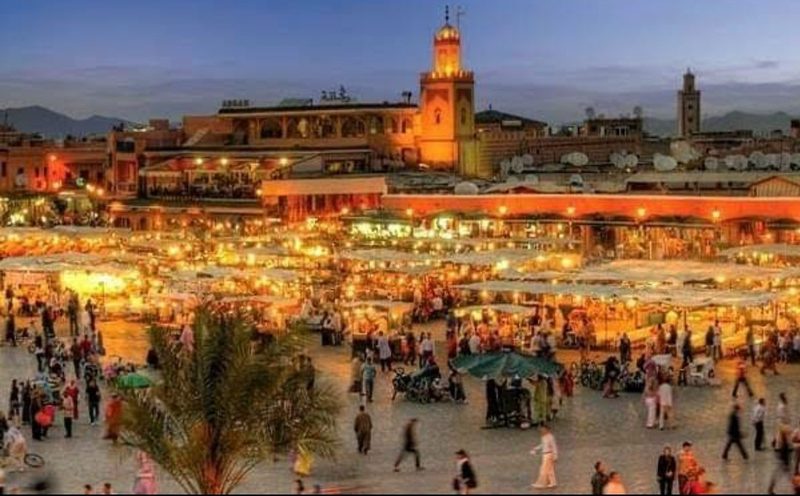
Marrakesh lets you in through the gate, turns you around, offers you a mint tea, and then you realize that three hours have passed, you have two rugs in your hands, your wrists are hennaed, and you have lost your way. Getting lost in this city is okay, it's part of the plan.
The southern capital of Morocco, the snow-capped peaks of the Atlas Mountains in the north, the warm breath of the Sahara in the south. Its population is around one million, but in the narrow streets of the Medina it feels like ten million. One of the four royal cities, Marrakesh has been the meeting point of merchants, travelers and dreamers for millennia.
The city consists of two main areas: the historic Medina (the walled old town) and the French colonial-era Ville Nouvelle (the new town, Gueliz and Hivernage neighbourhoods). Time seems stuck in the 12th century in the Medina — narrow streets, donkey carts, covered suks, courtyard riads. In Gueliz, there are boulangeries, cocktail bars and concept stores. It's a ten-minute walk between the two worlds, a transition that is disorientingly beautiful every time.
The magic of Marrakech lies in its contrasts. You wake up at 7 in the morning with the call to prayer, at 8 you have breakfast under the orange tree in the courtyard of the riad, at 10 you examine the geometric tile patterns in the thousand-year-old madrasah, at noon you eat the best lamb in the world for 30 liras at a street stall, in the afternoon you review the history of fashion in Yves Saint Laurent's garden, in the evening you come face to face with a snake charmer in the world's craziest square, at night you look at the stars on the roof of a riad. While sipping mint tea, the call to prayer gets louder again. A day goes like this.
Marrakech may seem far away from Istanbul, but culturally it is surprisingly familiar. There is the tea culture (mint tea is as sacred as our tea), there is the bargaining culture (Istanbul Grand Bazaar and Marrakech Medina are siblings), there is the bath culture, there is hospitality. But it's a slightly more intense, slightly more colorful, slightly more chaotic version of everything. You are comfortable in Istanbul Grand Bazaar, but here you open up another level.
When to Go
Marrakesh's weather is summed up in two words: hot dry. But if you choose the right time, it's heaven, if you choose the wrong time, it's a tandoor oven.
March - May (Spring): Marrakech's golden age. The weather is 22-28 degrees, the gardens are in bloom, there is still snow in the Atlas Mountains. April is the ideal month — neither hot nor cold, you can walk everywhere. Prices are high season but worth it for this weather.
October - November (Autumn): Quality close to spring. 20-26 degrees, tourist density is lower than spring, prices are more affordable. In mid-November you can sometimes get rain, but it's usually sunny. If you're going for the first time, October is the perfect choice.
June - September (Summer): 35-45 degrees. In July-August, the narrow streets of the Medina are like an oven. Going out during the day is torture, but prices are at rock bottom and there are no crowds. Plan for early mornings and late afternoons, and spend afternoons at the riad's pool or hammam. It's a budget-friendly option if you can tolerate the heat.
December - February (Winter): 10-18 degrees, may drop to 5 degrees at night. There is not much central heating in Marrakech's riads, so you pile up blankets and sleep at night. But the day is sunny and perfect for street exploring. Hotel prices skyrocket during the New Year period.
Short answer: aim for April or October. If the budget is limited, early June or late November.
How to get there
Turkish Airlines has a direct flight from Istanbul to Marrakesh — approximately 4.5 hours. You land at Menara Airport (RAK). THY operates several flights a week, the frequency varies depending on the season.
The average round-trip ticket price for economy class varies between 200-400 EUR. The best prices are generally seen in June-August and November. New Year's Eve and Easter are the most expensive times. Early booking (2-3 months in advance) makes a serious difference.
There are also connecting options other than THY: Royal Air Maroc (transfer to Casablanca), Ryanair or Wizz Air (cheap options with connection to Europe). Connecting flights can sometimes be 100 EUR cheaper.
Menara Airport is only 6 km from the city center — Marrakesh is very lucky in this regard. Your transportation options:
- Taxi: There is a fixed price taxi stand at the airport exit. 70 MAD to Medina, 50 MAD to Gueliz. The price is written on the table, no bargaining. It takes 15-20 minutes.
- Transfer service: The Riad can organize a transfer, usually 100-150 MAD. Since you cannot pass through the narrow streets of the Medina, you leave it at the nearest point and walk from there.
- Bus: No. 19 airport buses go to Jemaa el-Fnaa. 30 MAD, 20-30 minutes. Ideal if you have little luggage and are adventurous.
Tip: Cars are not allowed in the riads in the Medina. The taxi goes to the Medina gates (Bab), from there you have to walk or hire a wheelbarrow. When you first arrive, ask someone from the riad to greet you at the door.
Urban Transportation
Transportation in Marrakech is not as complicated as Bangkok or Tokyo because the city is walkable. But knowing a few things makes life easier.
Walking: The only transportation in the Medina is walking. The streets are narrow, cars are not allowed (except motorcycles — be careful, they come from behind without horns). Google Maps does not work most of the time in the Medina because the streets are a maze. Maps.me app is better for offline maps. But the best navigation method: accept getting lost and make eye contact with someone, "Jemaa el-Fnaa?" And it will show the way.
Taxi (Petit Taxi): Beige colored small taxis for urban transportation. There is a taximeter, but sometimes they don't want to turn it on — say "compteur, s'il vous plaît" (taximeter please). 15-25 MAD from Medina to Gueliz, 25-35 MAD to Menara Gardens. Prices increase by 50% at night.
Calèche (Horse Carriage): Horse carriages tour around Jemaa el-Fnaa. Touristic but fun, especially with kids. 30 minute tour costs 150-250 MAD, bargain.
Bus: There are ALSA city buses, 4 MAD. But knowing the route is difficult and crowded. Not very useful as a tourist.
Car Rental: It is unnecessary in the city, but it makes sense for daily tours such as the Atlas Mountains and Essaouira. Manual transmission is common, automatic is hard to find and expensive. Traffic rules are enforced as "recommendations", drive defensively.
Golden rule: Walk within the Medina, petit taxi from Medina to Gueliz, use Careem (Uber of Morocco) for long distances.
Accommodation Regions
Where you stay in Marrakesh directly affects the enjoyment of your holiday. And here the answer is clear: stay in the riad. If you come from cities where there are hotel chains, the riad experience will take you to a different dimension.
What is a Riad? An ordinary door from the outside, when you enter it is a small palace with a courtyard, a fountain and orange trees. These houses, hidden behind the narrow streets of the Medina, have been restored as hotels. Roof terrace is standard, most have small pools. Breakfast is served in the courtyard — msemen (pancakes), freshly squeezed orange juice, olives, cheese, honey.
Medina (Old City): Most of the Riads are here. You wake up in the middle of street life, within walking distance of Jemaa el-Fnaa. Disadvantage: carrying your suitcase through narrow streets, noise at night, sometimes mosquitoes. 40-200 EUR per night.
Gueliz / Ville Nouvelle: Modern hotels, boutique hotels, apartments. Restaurants and bars are within walking distance. For those who want to escape from the chaos of the Medina in the evening. 50-250 EUR per night.
Hivernage: Luxury hotel zone. Chain hotels such as Sofitel, Movenpick, Es Saadi are here. With pool, spa, fully equipped. Close to nightlife. 100-500 EUR per night.
Palmeraie (Palm Garden): Luxury villas and resorts outside the city, in the palm forest. Pool, garden, silence. But 20 minutes taxi to the city. For honeymoon and complete relaxation holiday. 150-800 EUR per night.
Recommendation: If it's your first time, stay in a riad in the Medina, that's half the Marrakech experience. Booking.com has a "riad" filter, choose those with 4+ points and 100+ reviews.
Budget Plan
Marrakesh is very affordable compared to Europe, but not as cheap as Southeast Asia. Still, the value for money ratio is excellent. Here is the approximate budget table for 3 days (per person, excluding flights):
| Category | Economical | Medium | Luxury |
|---|---|---|---|
| Accommodation / night | 300 MAD (simple riad) | 800 MAD (beautiful riad) | 3,000 MAD+ (luxury riad/hotel) |
| Meal/day | 100 MAD (street) | 400 MAD | 1,500 MAD+ |
| Transportation / day | 30 MAD (walking + taxi) | 80 MAD | 300 MAD |
| Activity / day | 100 MAD | 300 MAD | 1,000 MAD |
| 3 days total | ~1,590 MAD (~145 EUR) | ~4.740 MAD (~430 EUR) | ~17,400 MAD (~1,580 EUR) |
1 EUR is approximately 11 MAD (May 2026 exchange rate). 100 MAD is about 9 EUR.
Street food in Medina costs 20-50 MAD (2-5 EUR), mint tea 10-15 MAD, orange juice 5 MAD, taximeter distance 15-30 MAD. A budget-conscious person can easily get by on less than 50 EUR per day. The most expensive item in Marrakech is accommodation — a nice riad costs between 80-200 EUR per night.
Tipping culture: Add 5-10% at the restaurant or MAD 10-20 to the bill. 20-30 MAD per day for the Riad staff, 50-100 MAD for the tour guide, 30-50 MAD for the bath bag.
Practical Tips
- Negotiation is a must but be respectful. The initial price is usually 3-4 times the real one. Start with a third and negotiate with a smile. Say "non merci" and start walking, the price will drop. But don't be insulting, it's a game and both sides know it.
- Do not refuse mint tea offer. If the shop owner offers tea, this is not sales pressure, it is hospitality. Drink, chat, you don't have to take it.
- Faux guides Approach tourists who look "lost" in the Medina and say "let me take you", then ask for a tip or shop commission. Politely decline. If you get really lost, ask the shopkeeper, most are helpful.
- Be careful when taking photos. Snake charmers, monkey performers, water sellers (guerrab) ask for money in exchange for photos. Ask before taking photos or prepare 10-20 MAD.
- Female travellers: Marrakesh is generally safe, but street harassment (challenging, stalking) may occur. Ignore it and keep walking. Avoid the deserted streets of the Medina late in the evening and use the main streets.
- Carry cash. Credit cards are accepted in big hotels and Gueliz restaurants, but everything is cash in Medina. ATMs are plentiful around Jemaa el-Fnaa and in Gueliz. Change a small amount at the airport (commission is high), withdraw from ATM in the city.
- Drink bottled water. Tap water is not safe. Bottled water costs 5-7 MAD everywhere. Carry plenty of water on hot days.
- Knowing French makes life easier. “Bonjour” (hello), “merci” (thanks), “combien?” (how much?) and "c'est trop cher" (too expensive) are enough. It is a great advantage if you know Arabic, the common words between Turkish and Arabic will surprise you.
- Socket type C and E. Compatible with Turkish sockets, no adapter required.
- eSIM or local SIM: Get a Maroc Telecom or Orange SIM card at the airport. Tourist package 30-50 MAD, data is sufficient. Download the Maps.me app offline, mobile data can be weak in Medina.
- Friday noon many shops and some venues close for Friday prayer (between 12:00-14:00). Make your plan accordingly.
Travel Guide with Children
Can you go to Marrakech with children? Absolutely yes, but it takes some preparation. Moroccan culture is very welcoming to kids — you hear smiles, treats, and “mashallah” sounds everywhere. The chaotic streets of the Medina are an adventure for children and a bit of stress for parents.
Recommendations by Age Group
0-3 years: Baby stroller is impossible in Medina, kangaroo carrier is a must. Riads are generally baby-friendly — there's a crawl space in the courtyard and baby food is heated in the kitchen. Stay at the riad during hot hours.
4-7 years old: The riot of colors of the Suks fascinates this age group. The horse carriage (calèche) tour is perfect for kids. Turtles and cacti in the Majorelle Garden attract attention.
8-12 years: Take a treasure hunt-like exploration tour of the Medina. The dyeing process in leather workshops, baking lamb in the oven, pottery workshops — interactive experiences are ideal at this age.
Ages 13+: A great opportunity to teach negotiation. Give them a budget in Suks and let them do their own shopping. Trekking or camel tours in the Atlas Mountains attract young people.
Top 5 Kid-Friendly Activities
Calèche (Horse Carriage) Tour — City tour starting from Jemaa el-Fnaa. Kids love the horses, it takes 30-45 minutes. 150-250 MAD, bargain.
Camel or Donkey Tour (Palmeraie) — 1-2 hour camel tour in the palm garden. Unforgettable experience for children. 200-400 MAD/person.
Majorelle Garden — Colorful walls, turtles, cactus garden. It's fun for kids to take photos. There are wide walking areas.
Jemaa el-Fnaa Evening Performances — Acrobats, musicians, storytellers. Live theater for children. Watch out for snakes and monkeys — some children may be scared.
Cooking Workshop (Family version) — Places like La Maison Arabe and Dar Cherifa offer family cooking classes. Children roll out the dough and smell the spices. 300-500 MAD/person.
Practical Information
Baby stroller: Cannot be used on the streets of Medina. There are narrow, paved, stepped streets and motorcycle traffic. Kangaroo carrier or backpack is a must. You can use a stroller in Gueliz.
Children's menu: Moroccan cuisine is less spicy, children generally like tagine, couscous and fried chicken. Bread (khobz) is on every table. Msemen (pancakes) are a children's favorite.
Hygiene: Be careful with young children when eating street food - choose hot cooked meals. Carry plenty of wet wipes and hand sanitizer. Riads are generally clean.
Sun protection: There is a high risk of sunstroke in children during hot months. Hat, sunscreen (SPF 50+), plenty of water. Do not go out between 12-15 noon.
Toilet: Public toilets in the Medina are few and in poor condition. Use in cafes and restaurants. Always carry paper napkins.
Warnings
- On the streets of Medina, motorcycles come without warning, hold the children's hands.
- Snake charmers and monkey performers attract children but the animals are not trained, keep distance.
- Warm months (June-August) are very challenging with children, choose spring or autumn.
- Getting lost in the Medina is fun for adults, but little kids might panic — figure out the main itineraries in advance.
Local Label and Culture Notes
Morocco is a Muslim country, but it has a level of openness comparable to Istanbul. There is a relaxed atmosphere in the tourist areas, but knowing a few cultural codes shows respect and makes life easier.
Islamic sensitivities: Non-Muslims cannot enter mosques (exception: Hassan II Mosque, Casablanca). Do not eat, drink or smoke outdoors near local people during Ramadan. Lower your voice level while reciting the adhan. These are not obligations, but serious rules of courtesy.
Clothing: Short shorts and halter tops do not cause any problems in the Medina and touristic areas, but if you want to attract less attention, it is comfortable to dress with your knees and shoulders covered. Especially for women — no one enforces the dress code, but in conservative neighborhoods the stares are felt.
Left hand: Use the right hand when eating, greeting and handing something. The left hand is traditionally considered unclean. Right hand even when tearing bread.
Photo permission: Ask before taking photos of people. "Photo?" say and smile, most will accept. If they refuse, be respectful. Older women usually don't ask for photos.
Alcohol: Alcohol sales are regulated in Morocco. Supermarkets have separate alcohol sections (Carrefour, Marjane), some restaurants and hotels serve alcohol. Drinking alcohol openly on the streets of Medina. The bars in Gueliz and Hivernage are cozy.
Bargaining etiquette: Bargaining should be firm but respectful. Don't insult, don't make fun of me. If you don't want to, say "la, shukran" (no, thank you) and walk away. If you agree on the price, you have to buy it — it's a shame to agree and not buy.
Tip (pourboire): It is expected everywhere. 5-10% at the restaurant, 10-20 MAD for the hotel carrier, 50-100 MAD for the guide, 30-50 MAD for the bath bag. For small help (directions, opening doors) 5-10 MAD.
Salam: "Salam aleykum" (salam aleykum) is the most common greeting. Its equivalent is "wa aleykum salam." We should point out that those who speak Turkish immediately felt sympathetic in Morocco with this greeting.
FAQ
How many days to visit Marrakech? Minimum 3 days, ideal 5-7 days. You can fit in exploring the Medina, Jemaa el-Fnaa, a few museums and Suk in 3 days. Atlas Mountains or Essaouira day tour is added in 5 days. You really get to enjoy Morocco in 7 days.
Is Morocco safe? In general yes. Police presence is heavy in tourist areas. Things you need to watch out for: pickpockets (carry your wallet in the inside pocket and your purse in front), fake guides (who ask for guidance and a tip), and overly pushy salesmen. Violent crime against tourists is rare.
Is there a language problem? In tourist areas, French and basic English are sufficient. Arabic and Berber are spoken in the sukta and on the streets, but shop owners can usually quote prices in several languages. Common Turkish-Arabic words (şükran, salam, halal) help you establish connections.
Is street food safe? Generally yes, especially the stalls in Jemaa el-Fnaa are under municipal control. Choose places with queues and choose hot cooked meals. Sensitive stomachs should stay away from salads and raw vegetables. Orange juice is safe, it is squeezed right in front of you.
Is it a problem to go during Ramadan? No, but you get a different experience. Some restaurants are closed during the day (tourist attractions are open). The city takes on a magical atmosphere during iftar time. It is an important rule of courtesy not to eat in the open in front of local people.
Where to visit on a day trip from Marrakech? Ouzoud Waterfalls (2.5 hours, nature), Essaouira (2.5 hours, ocean and wind), Imlil/Atlas Mountains (1.5 hours, trekking and villages), Ait Benhaddou (3.5 hours, UNESCO castle-village, Game of Thrones shooting location).
What to buy? Leather babouche (traditional slippers), argan oil (there is a cosmetic and culinary version), spices (ras el hanout mixture), ceramic plates, metal lamps, berber rugs. Buy argan oil from cooperatives, original guaranteed.
What is the Turkish bath experience like? The traditional hammam (hammam) is similar but different from the Turkish bath. You are washed with black soap (savon noir), rubbed with a scrub glove, and massaged with argan oil. Local baths are 10-20 MAD but hygiene standards may be low. Tourist baths are 200-500 MAD, more comfortable.
Riad or hotel? Definitely a riad if you're coming to Marrakech for the first time. Authentic, personal service inside the Medina. Disadvantages: some are very small (3-5 rooms), transportation from the streets of the Medina is sometimes difficult, air conditioning is not available everywhere. If comfort is a priority, modern hotels in Gueliz or chain hotels in Hivernage.
ATM and money exchange? Moroccan Dirham (MAD) is not available outside the country, change it when you arrive. There is an ATM at the airport, but the commission is high, minimum check. ATMs in the city (BMCE, Attijariwafa) are more convenient. Credit cards are accepted in large venues, but cash is required in Medina.