About
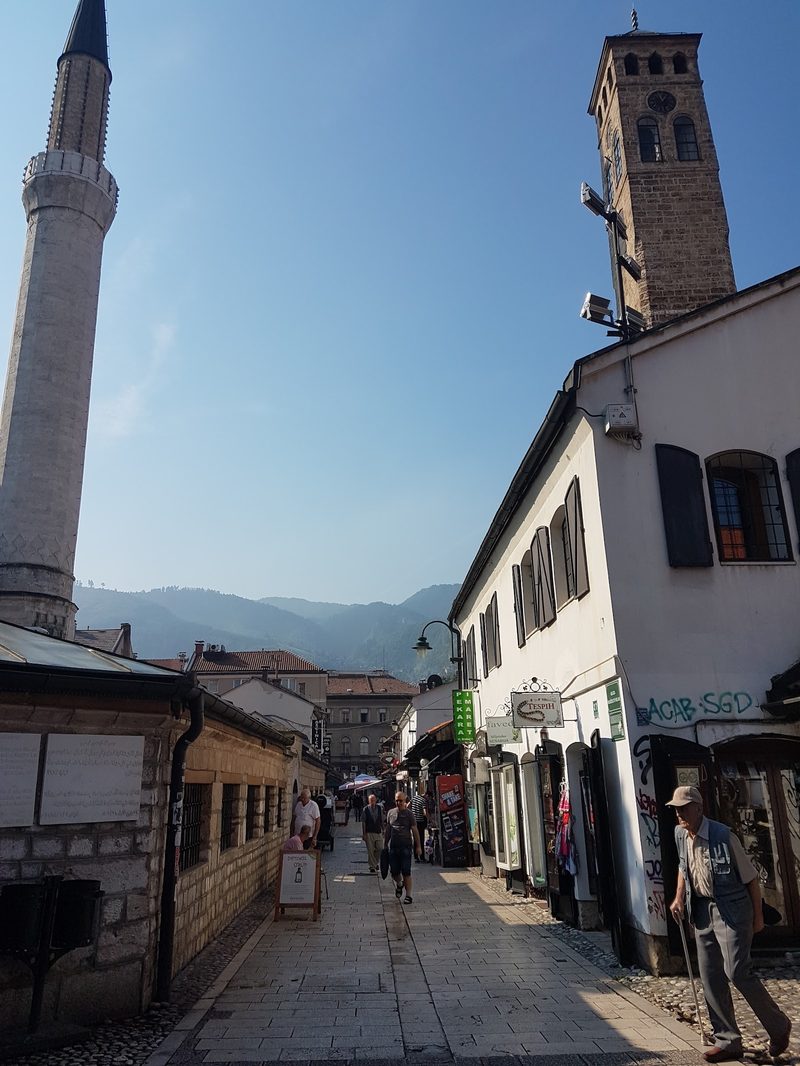
Sarajevo lies in a long valley surrounded by mountains. When you first see the city, what you notice is not the silhouette, but the sound: While the adhan is being called from the Gazi Hüsrev Bey Mosque, the bell of the St. Heart Cathedral is ringing a few streets away, the service of the Old Orthodox Church is continuing further down, and there is a guitar playing Sephardic melodies in a terrace cafe on Ferhadija street. It's not for nothing that this city is called the Jerusalem of Europe — four religions, four architectures, four culinary traditions live side by side within 200 meters.
The day begins with coppersmith's hammers in Bascarsija, ends with the weight of 1914 on the Latin Bridge, with the nightmare of the 1990s in the Tunnel Museum, and ends with the resistance of a surviving city when viewed from the Trebević cable car in the evening. Sarajevo has accumulated history in every corner, but it does not present it as a tourist museum, it presents it in daily life. You're having lunch at an answering restaurant, and the uncle next to the table is telling you his war story — unintentionally, just starting a conversation.
Sarajevo is a different category for the Turkish traveler. Languages are not related, but culture is related: Turkish coffee, baklava, pastry, stuffed vegetables, love music... Bosnians refer to the Ottoman period as the 'Turkish period' and generally remember it positively. You often come across people who say "Mi smo braca" - we are brothers. This closeness may sometimes seem exaggerated, but it is sincere: They do not speak Turkish, but Turkish words are in every sentence. "Komšija" (neighbor), "hello", "babo" (father), "bakšiš" (tip), "ćevap" (answer)... The list is endless.
Contrary to popular belief, Bosnian cuisine is not just the answer. Begova soup (lamb meat and yoghurt soup), japrak (stuffed cabbage), klepe (Bosnian dumplings), tufahija (walnut and apple dessert) and Bosnian coffee accompanied by sevdah music — this table is like a branch of Anatolia. But with a difference: you eat all this for half the price of Europe. Sarajevo is cheap. 200-300 EUR of the budget for a full three-day holiday is enough. You cannot find this amount of cultural intensity at this price anywhere else.
When to Go
Since Sarajevo is in a valley, winters are cold but summers are cool. The mountain effect is felt in every season.
| Period | Weather (daytime) | Density | Otel Fiyatı | Notes |
|---|---|---|---|---|
| January-February | -3 / 5° | Low | Low | Snowfall guaranteed, close to Jahorina and Bjelašnica for skiing |
| March | 2 / 12° | Low | Low | It's the beginning of spring, there's still snow in the mountains |
| April | 6 / 17° | Low-Medium | Medium | The city is green, it might be rainy |
| May | 10 / 21° | Medium | Medium | The most beautiful beginning, flowery courtyards |
| June | 13 / 25° | Medium-High | Medium | Ideal; long days, nightlife in cafes |
| July | 15 / 27° | High | High | Hot but not humid, evenings are cool |
| August | 15 / 27° | Very High | Very High | Film Festival; hotel prices are at their peak |
| September | 11 / 22° | Medium-High | Medium | Best month; ideal for long walks |
| October | 7 / 16° | Medium | Low-Medium | Autumn colors, enchanting view in the mountains |
| November | 2 / 9° | Low | Low | It's rainy, but there's Jazz Fest |
| December | -1 / 5° | Medium | Medium | New Year's markets, ski season begins |
If you ask me, end of May-mid June and September are ideal. August Film Festival is good for those who want excitement, but it becomes difficult to find a hotel and prices double. If you come in winter, you can add a day of skiing in Jahorina — 30 km from Sarajevo, there is a bus service.
How to get there
Sarajevo's airport, Sarajevo International Airport (SJJ), is 12 km southwest of the city center. Small but tidy.
Flights from Türkiye:
| Exit | Duration | Airline |
|---|---|---|
| Istanbul (IST) - SJJ | 2 hours 5 min | THY (twice a day) |
| Istanbul (SAW) - SJJ | 2 hours 10 min | Pegasus (4-5 times a week) |
| Ankara (ESB) - SJJ | 2 hours 20 min | THY (2-3 times a week, seasonal) |
THY direct flights are frequent and reliable. Pegasus is cheaper but flight hours are early morning/late night. Mediocre price is 120-180 EUR round trip, if you buy early it goes down to 90 EUR.
From airport to city:
- City minibus (Centrotrans): 30-40 min, 5 KM (~2.5 EUR), up to Baščaršija. It is the cheapest option, but hours vary depending on flight density.
- Taxi: 15-20 min, 20-30 KM (~10-15 EUR). Airport taxis have a fixed price board, no bargaining.
- Bolt: 15-20 min, 12-18 KM (~6-10 EUR). The application works, it is the most practical option.
Our recommendation is Bolt — price transparent, no language issues. Call Bolt with free wi-fi at the airport.
Transportation by bus: Belgrade 7 hours, Zagreb 8 hours, Mostar 2.5 hours, Istanbul 24 hours (yes, there is). The bus is very practical for a day trip to Mostar.
Urban Transportation
Sarajevo is compact — the center is walkable. But public transportation is a must for the slopes and foothills.
Tram: Europe's oldest electric tram, opened in 1885 (even before Vienna). There are 7 lines, the main line is Ilidža-Baščaršija. The old red wagons are nostalgic, but there are new ones too.
Tram ticket: Single ticket 1.80 KM (~1 EUR, 2 KM if you buy from the driver). Buy tickets from the kiosks in your neighborhood, it's cheaper. When you board, be sure to press the confirmation machine — the controller comes frequently, the penalty is 40 KM.
Bus and trolleybus: It goes to the slopes where the tram does not go. For the Trebević cable car you need a bus to Bistrik, for Vrelo Bosne you need a bus after the tram to Ilidža.
Taxi/Bolt: Bolt works, 5-10 KM (~3-5 EUR) within the city. Calling a taxi on the street - it has a meter but some people forget to turn it on.
Walking: The Bascarsija-Vijećnica-Latin Bridge-Ferhadija route is completely walkable. Only Vratnik hill (Yellow Bastion, Kibe Mahala) is a slope. The streets are cobblestone, comfortable shoes are mandatory.
Accommodation Regions
Sarajevo is small, easy to reach no matter which neighborhood you settle in, but their atmosphere is very different.
- Baščaršija (Stari Grad): In or right next to the Ottoman bazaar. You wake up in the morning to the call to prayer and the sound of coppersmith's hammers — ideal for the atmosphere lover, not if you want deep sleep. 30 seconds away from restaurants and coffee shops. For couples and short holidays.
- Marijin Dvor: The Austro-Hungarian heart of the city, shopping malls, modern hotels, wide streets. Tram is easy in all directions. Practical for business trips and families. The beginning of Sniper Alley, some quieter evenings.
- Bistrik: Hill town below the Trebević cable car. Steep streets, old Ottoman houses, panoramic balconies. Air-bnbs are plentiful and cheap. Ideal for those who love hiking and photography.
- Ilidža: 12 km west of the city center, close to the airport. Walking distance to Vrelo Bosne, there is a thermal hotel option. 30 minutes to the city by tram. For families and nature-oriented holidays.
- Skenderija: Between Marijin Dvor and Bascarsija, quiet neighborhood. Local neighborhood atmosphere, cafes and bars are busy. Good choice for long stay.
What we do not recommend: Doğlavi and Hrasnica are too remote, suburban-like; Dobrinja is cheap, but it is difficult to reach the center and has heavy war scars.
Budget Plan
Sarajevo is very cheap by European standards. At the level of Belgrade and Skopje, half of Zagreb.
| Budget Style | Accommodation | Food | Activity/Transportation | Total (2 people/3 days) |
|---|---|---|---|---|
| Economic (hostel/2* hotel, street food) | 90 EUR | 60 EUR | 30 EUR | ~180 EUR |
| Moderate (3-4* hotel Bascarsija, restaurant) | 200 EUR | 110 EUR | 60 EUR | ~370 EUR |
| Comfort (boutique hotel, gastronomy) | 400 EUR | 200 EUR | 90 EUR | ~690 EUR |
| Luxury (Europe Hotel, Hotel Bristol) | 800 EUR+ | 350 EUR | 130 EUR | ~1.280 EUR+ |
Practical items: Bosnian coffee 2-3 KM (~1-1.5 EUR), answer portion 10-12 KM (~5-6 EUR), burek 200 g 4-6 KM (~2-3 EUR), Sarajevsko draft beer 3-4 KM (~1.5-2 EUR), tram single ticket 1.80 KM (~1 EUR), Trebević cable car 20 KM (~10 EUR), Tunnel Museum 10 KM (~5 EUR), baklava + coffee 8 KM (~4 EUR).
Practical Tips
Currency: Bosnian currency Konvertibilna Marka (BAM/KM), fixed rate: 1 EUR = 1.96 KM. Euro is rarely accepted but at a bad exchange rate. Check or exchange KM — airport rate is not good, use Raiffeisen ATMs in the city centre. The card is accepted almost everywhere, except for bazaar shopkeepers and small restaurants. There is almost no exchange of Turkish Lira, bring dollars or euros.
Water: Sarajevo's tap water is drinkable, mountain source. No need to buy a bottle. The water of Sebilj Fountain is also drinkable, according to local belief, if you drink it, you will come back.
Language: Bosnian is spoken, but don't worry if you don't know it — most people over middle age recognize mixed Turkish-Bosnian words, young people generally speak English. "Hvala" (thank you), "molim" (you're welcome), "dobar dan" (hello) are enough. Turkish "hello" also works — without exaggeration, with a smile.
Smoking: Smoking is allowed inside cafes and restaurants. Bosnia is not the EU, smoking bans are loose. If you're sensitive to air quality, ask for an outdoor table, especially in the winter.
Tip: 10% of the bill is standard in the restaurant. It is not necessary for street food restaurants like Çarşambaçı. Rounding is sufficient for taxis (if it is 10 KM, give it 11 KM). If you leave a mark to the coffee shop, you will win hearts.
Sarajevo Roses: If you see star shapes on the ground filled with red resin — these are scars left by mortar hits, in memory of the civilian dead. Don't step on it, move around quietly.
Sundays: Most shops are open but museums like Vijećnica have limited Sunday hours, so check.
Bargain at the bazaar: You can ask for a 10-15% discount at handicraft shops, but don't exaggerate. Bosnians do not like bargaining, prices are honest anyway. "Would it be cheaper?" instead of "What do you do if I buy two?" gives better results.
Travel Guide with Children
Sarajevo is a small, compact city that can be visited with children. But filter the weight of your date by the child's age.
Recommendations by Age Group
0-3 years: Vrelo Bosne green and smooth, ideal for strollers. Bascarsija is paved with stones and is slightly rough. The tram is old-fashioned, shaky — hold on tight to the baby. Veliki Park (Marijin Dvor) is baby friendly and has a playground.
4-7 years: Trebević cable car is a great adventure, kids love it. Carriage tour in Vrelo Bosne, meeting with swans, feeding ducks. Feeding pigeons at the Sebilj Fountain is classic. The bobsleigh track is fun, not graffitied or scary.
8-12 years old: Tunnel Museum can be very powerful depending on the age group, prepare the narration in advance. Vijećnica's colorful stained glass atrium fascinates children. Olympic Museum The story of the Sarajevo winter of 1984 — children who are fond of skiing and ice skating love it. If you tell the story of the Latin Bridge in a simplified manner, it would be like a history lesson.
Ages 13+: See Sniper Alley and the Sarajevo Roses, tell about the history of the war. Mostar day tour — bridge divers attract teenagers' attention. Trebević bobsleigh track is a photo raksvot for the graffiti enthusiast. Sarajevo Film Festival holds open-air film screenings in August — unforgettable for young people.
Top 5 Kid-Friendly Activities
Trebević Cable Car + Bobsleigh Track — 7-minute hike up the hill, walking on the graffitied abandoned track above. Seeing the traces of the Olympics + the sense of adventure is more than enough for children.
Vrelo Bosnean Horse-drawn Carriage Tour — Passing by carriage along the plane tree road, walking by the river with swans, watching the water from stone bridges. Escape from city noise.
Pigeon Feeding in Sebilj Square — Like classic Istanbul squares, kids will be entertained for hours. Enjoy a pleasant break with a Bosnian coffee (you) + paste (child).
Olympic Museum — In the city center, memorabilia of the 1984 Winter Olympics. Medals, uniforms and ski equipment are on display. Great for the kid who loves sports.
Tram Tour — Europe's oldest electric tram, dating from 1885. Line number 3 Ilidža-Bascarsija covers the whole city, 45 minutes. The kids watch the view from the window, you rest.
Practical Information
Baby stroller: The stone flooring in Bascarsija is difficult, choose sturdy wheels. Marijin Dvor and Ferhadija are smooth, smooth. You can take the Trebević cable car by car.
Children's menu: Children's portions are common in Bosnian restaurants. The answer is, klepe, palacinka (pancakes) are options that children love.
Discounts: In most museums, children under 6 are free, 6-18 are half price. Public transportation is free for children under 6 years old.
Toilet: Available in cafes, clean in shopping malls. There are few paid toilets on the street.
Warnings
- Smoking is available in every indoor place, if you have asthma or sensitivity, choose the outdoor table.
- Videos and photos of the Tunel Museum may be heavy for young children, check them at the door.
- Do not enter unmarked areas on the Trebević hiking trails — there is still a mine danger in the mountain areas far from the city, do not go off the trail.
- Vehicle traffic is narrow on the hilly streets, do not let go of the child's hand.
Local Label and Culture Notes
Bosnians are hospitable but aloof. If you say hello, you will see a smiling face; if you are not noisy, you will be loved. When you say you are Turkish, the warmth usually increases, but do not create exaggerated expectations of brotherhood - for the Bosnian, you are a 'komšija' (neighbor), not a brother. Respectful distance is best.
Greeting: A handshake is standard, a two-cheek kiss between acquaintances is common. "Dobar dan" (hello), "kako si?" (How are you?) That's enough. Saying "hello" in Turkish is considered sweet.
Restaurant rules: The waiter greets you at the door and shows you the seat. Don't wait for the menu when you come to the table — Bosnians are unhurried, the waiter will give you time. Eye contact is enough to ask for an account.
Tip: 10% of the bill is standard. Not necessary in street food shops. If you leave 1-2 KM to the coffee shop, your name will be remembered the next day.
Bosnian Coffee (Bosanska Kahva): It is related to Turkish coffee, but there are differences: preparation, presentation, drinking protocol. The coffee pot (džezva) is cooked on embers, not on fire. It comes with a small cup (fildžan), a sugar cube (like a lokum lokum), and a glass of water. Drink water before coffee. Bite the sugar and melt it in your mouth, then sip the coffee — you don't put sugar in coffee, the opposite of tradition. The best place to drink with sevda music is the coffee house (kafana) — there are dozens of them in Bascarsija.
Sevda: The name of Bosnian folk music. Love songs sung to the accompaniment of oud, accordion and saz. There are makams that will be familiar to Turkish listeners. There are live love concerts in some cafes in the evenings, don't miss it.
Religion: In Sarajevo, the call to prayer in the mosque, the bells in the church, the prayer in the synagogue — all are part of the same city agenda. Be respectful, ask permission inside places of worship when taking photos. Stay away from mosques during Friday prayer time, they get crowded.
Smoking: Smoking is allowed inside in most cafes. If this seems weird to you, ask for an outdoor table — don't look judgmentally, it's a cultural thing.
FAQ
How many days to visit Sarajevo? Three days is ideal to see the main attractions — Bascarsija, Tunel Museum, Vijećnica, Trebević, Vrelo Bosne are enough. Five days is comfortable, you can add a day trip to Mostar. One week is the right time for both the city, nature (Jahorina, Bjelašnica mountains) and the Mostar-Blagaj tour.
Is Sarajevo safe? Yes, safe by European standards. Even at night the city center is quiet. Even pickpocketing is rare. Be careful to only venture into unmarked areas in the mountains — demining is still ongoing in some rural areas, so don't go off-track. The city center is completely safe.
Should I use KM or Euro? Konvertibilna Brand (KM/BAM). The exchange rate is fixed, 1 EUR = 1.96 KM. Euro is accepted in some tourist attractions but with a bad exchange rate. Bolt, supermarket, restaurant, everywhere accepts cards. When withdrawing from an ATM, reject the "conversion" offer, your own bank will give a good exchange rate.
How is Bosnian food, what should I try? It is very close to the Turkish palate. Be sure to try: answered (grilled, not meatballs), begova soup (lamb soup with yoghurt), japrak (stuffed cabbage), klepe (Bosnian dumplings), burek (Bosnian pastry), tufahija (apple dessert with walnuts). As drinks: Sarajevsko draft beer, rakija (plum), Bosnian coffee. Ćevabdžinica Željo for the answer, Buregdžinica Sač for burek, Ramis for baklava.
Where to go on a day trip from Sarajevo? Mostar is the most popular (2.5 hours by bus, 25 KM one way), Blagaj dervish lodge and river source (30 min additional to Mostar), Visoko Bosnian pyramids (1 hour), Jajce waterfalls (2.5 hours), Travnik Ottoman city (1.5 hours). Mostar can fit into one day, but you need 2 days to really enjoy it.
Are there places where Turkish is spoken? It is not common, but some shopkeepers in Bascarsija speak Turkish, especially the older generation. The younger generation speaks English. Tourist places such as Answer Shops, souvenir shops and baklava shops respond to Turkish greetings with "hello brother". Agreement at the word level is always possible.
Can you go to Sarajevo in winter? Definitely. Snowfall is guaranteed (December-March), the city is white, the cafes are warm and full. Jahorina and Bjelašnica mountains are at 30 km, you can ski. New Year's markets are opening, the Bascarsija walk accompanied by mulled wine (kuhano vino) is unforgettable. The only drawback: the valley's air pollution increases in winter (houses using coal), be careful if you have asthma sensitivity.
Is Sarajevo expensive? Not a lot. One of the cheapest capitals in Europe. A meal costs 5-10 EUR, museum 3-5 EUR, hotel 30-70 EUR/night. A comfortable three-day holiday can easily cost 200-400 EUR (excluding flights). It is similar or slightly cheaper compared to Istanbul.