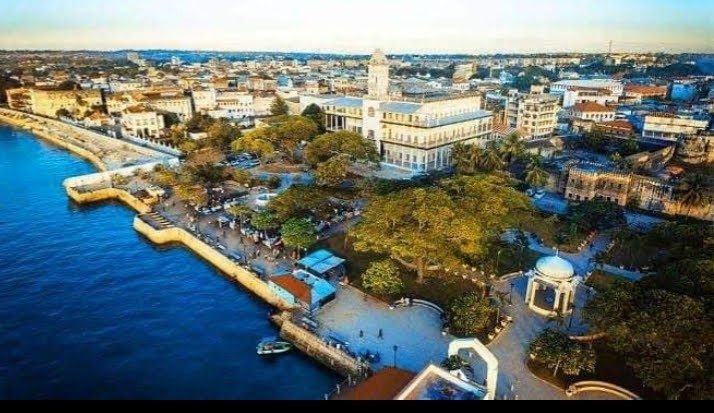
About
Zanzibar is a semi-autonomous archipelago within Tanzania — the main island, Unguja (popularly the name itself: Zanzibar), is 35 km off the coast of East Africa in the Indian Ocean. The story of the island is the story of a continent unto itself: Bantu Africans, Shirazi Persians, Omani Arabs, Indian traders, Portuguese, Germans, British—all have left their mark on this small island. The result: an Ottoman-Arab-Indo-African cultural crossroads unique in the world.
Stone Town (Mji Mkongwe, "Old Town") is concrete evidence of this intersection. In this neighborhood on the UNESCO World Heritage list, a mosque, church, Hindu temple and Zoroastrian house stand side by side on the same street. The famous carved wooden doors on the buildings are 200 years old — Arabic arches, Indian brass nails, African motifs, European hinges. Every door is a story. Local art historians consider the Zanzibar door as a separate art form.
The island's nickname "Spice Island" is not in vain. In the 19th century, 75% of the world's cloves came from this land. There are still active spice farms today — cloves, cinnamon, ginger, vanilla, coconut, cocoa. On the Spice Tour, a guide makes you pluck and crush the leaves and guess the scent; Smelling all these spices together is not a habit but an addiction.
It is also the center of a dark history. The East African slave trade operated from here for centuries, with up to 50,000 people sold annually at the Stone Town market. Today, visiting the dungeons under the Anglican Cathedral, built on top of the former slave market, is shocking but necessary. The island carries a heavy history beneath its visual appearance.
Then beaches. Nungwi and Kendwa are in the north — consistently in the top 10 on world beach lists, virtually unaffected by tides, turquoise all day. Paje and Jambiani are in the southeast — the tide is strong but this geography has created a kitesurfing paradise, one of the top 3 kitesurfing spots in the world. Mnemba Atoll is offshore — private island, protected reef with dolphins swimming around it.
There is also Freddie Mercury. Queen's legendary frontman Farrokh Bulsara was born in Stone Town in 1946, the son of a Parsi Zoroastrian family, and lived here until he was 8 years old. His childhood home is now a small museum. Read the lyrics of Bohemian Rhapsody again and think about the part that says "Bismillah" — the guy grew up on this island, naturally.
On a practical note: Zanzibar pizza in the evening at Forodhani Gardens costs 5,000 TZS (~2 USD), 10 times the same at the restaurant. If you get into local street food the real taste and budget is there.
When to Go
Zanzibar is close to the equator, and the seasons are dry and rainy. The temperature is 25-32°C throughout the year — basically avoiding two rainy seasons is enough.
| Period | Weather | Density | Otel Fiyatı | Notes |
|---|---|---|---|---|
| January-February | 28-32°C, hot humid | High | High | Dry season, perfect — but February Sauti za Busara |
| March-May | 26-30°C, long rain | Low | Low | AVOID — big rainy season, hotels closed, no swimming |
| June-September | 24-28°C, dry, windy | Very High | Very High | BEST SEASON — trade wind, kitesurf season, ZIFF July |
| October | 26-30°C, dry | High | High | Second best — still dry, prices starting to come down |
| November | 27-31°C, short rain | Medium | Medium | Short rainy season—rains short, sun all day |
| December | 28-32°C, dry | Very High | Very High | Christmas/New Year ceiling, reservations months in advance |
Best between June and October. June-September (kaskazi wind) is ideal for kitesurfing. July to September is safest for honeymoon — dry, cool, low humidity. Don't come in March-May — half the island is closed, the rain is serious.
How to get there
Zanzibar's airport, Abeid Amani Karume International Airport (ZNZ), is 7 km south of Stone Town.
Flights from Türkiye:
| Exit | Duration | Airline |
|---|---|---|
| Istanbul (IST) - DAR - ZNZ | 9 h 30 min + 30 min domestic | THY (daily, via Dar es Salaam) |
| Istanbul (IST) - ZNZ direct | 8 h 45 min | THY (seasonal, direct 4 days a week) |
| Istanbul (IST) - DOH - ZNZ | 11-13 hrs | Qatar Airways (via Doha) |
| Istanbul (SAW) - DXB - ZNZ | 12-14 hours | Pegasus + flydubai |
THY's seasonal direct flights are the easiest option (June-October, December-February). Transfer in Dar es Salaam (DAR) in off-season — Land in Dar, 30 minutes later, short flight to Zanzibar, transit within the same airport.
From airport to city:
- Taxi: ZNZ → Stone Town 20,000-30,000 TZS (~8-12 USD, 20 mins), ZNZ → Nungwi 60,000-80,000 TZS (~25-32 USD, 1.5 hours), ZNZ → Paje 50,000-70,000 TZS (~20-28 USD, 1 hour). If you book a hotel transfer it is generally more expensive but safe.
- Hotel shuttle: Free or nominal fee in 4-5 star hotels.
- Dalla dalla: Local minibus, very cheap (2,000-5,000 TZS) but very crowded, not recommended unless you are fluent in the language and local logic.
Ferry option: High speed ferry (Azam Marine) from Dar es Salaam to Stone Town 2 hours, 35-50 USD. An alternative if you have business in Dar or want to reduce your flight budget.
Urban Transportation
Zanzibar is a small island — 2 hours by car from north to south tip. But there is no such thing as "inner city", you go the long way between north and south beaches.
Taxi: The most common method. Fixed price, negotiable. It is safest to take a taxi from the hotel. There is NO Bolt or Uber in Zanzibar. Communication with taxi drivers via WhatsApp on the phone is normal.
Hotel/tour transfer: Most hotels arrange private transfers ($45-80 one way). Expensive but comfortable, air-conditioned vehicle, fixed price.
Dalla dalla: Local minibuses. Between 2,000-5,000 TZS goes to each city (Stone Town - Nungwi 4,000 TZS, 2 hours). It's very crowded, there is no air conditioning, it keeps stopping. Try it once for adventure.
Scooter/motor rental: 25-40 USD/day. Left lane (British colonial relic), traffic rules are flexible, police checks are frequent (they stop tourists for "bribes" — have an international driver's license ready). I wouldn't recommend it unless you are an experienced biker.
Car rental: 50-80 USD/day (auto more expensive). A local "Zanzibar permit" is required — you get it from your rental place (5 USD). Left Lane. It is not a logical option for most tourists, taxi is practical.
Accommodation Regions
Accommodation in Zanzibar varies greatly depending on geography. Choose according to which region appeals to you.
Stone Town (City): History + culture + restaurant density. There is no beach. Boutique hotels converted from old Arab mansions (Emerson on Hurumzi, Park Hyatt) are ideal for the atmosphere. Enough for 2-3 days.
Nungwi (North): The island's "crowded" beach, plenty of restaurants/bars/hotels. Beach where you can swim all day. Family + party mix. Option for all budgets (budget $30 - luxury $1,000/night).
Kendwa (Northwest): 3km south of Nungwi, quieter but Full Moon party hub. The beaches are quiet and lively at night. For young traveler and couple.
Matemwe (Northeast): More luxurious, quieter. The closest shore for the Mnemba Atoll tour. Honeymoon couples often come here. The beach is beautiful but affected by the tide (swimming is difficult at low altitudes).
Paje (Southeast): Kitesurf centre. Young, alternative, hippy traveler vibe. The swimming is challenging but the atmosphere is energetic. There is nightlife (Mr. Kahawa cafe + bar logic).
Jambiani (Southeast): Calm version of Paje. Fishing village feel, authentic. For those who want budget + silence.
Kizimkazi (South): Swimming with dolphins center. Going out to sea from the beach and swimming with dolphins — ethically controversial (wildlife interference) but popular. Otherwise, Kizimkazi is calm.
Classic 7 days route: Stone Town 2-3 nights + Nungwi/Kendwa 2-3 nights + Paje 1-2 nights or stay in Nungwi as a sole base and go to Stone Town as a day trip. Staying in a single luxury hotel for a whole week is also valid for honeymoon.
Budget Plan
The name Zanzibar sounds like "luxury holiday" but in reality it is a very broad spectrum. For the budget traveler, Asia is expensive, for the luxury honeymoon the Maldives is half the price.
| Budget Style | Accommodation | Food | Activity/Transportation | Total (2 people/7 days) |
|---|---|---|---|---|
| Backpacker (hostel, street food, dalla dalla) | 280 USD | 200 USD | 150 USD | ~630 USD |
| Moderate (3* hotel/guesthouse, mixed) | 700 USD | 450 USD | 300 USD | ~1,450 USD |
| Comfort (4* beach resort semi-full board) | 1,800 USD | 600 USD | 450 USD | ~2,850 USD |
| Luxury/Honeymoon (Mnemba, Park Hyatt, Zuri Zanzibar) | 6,000 USD+ | 1,200 USD | 800 USD | ~$8,000+ |
Practical items (TZS): Espresso 4,000-7,000 TZS (~1.5-3 USD), Kilimanjaro beer 5,000-10,000 TZS (~2-4 USD), street Zanzibar pizza 5,000 TZS (~2 USD), restaurant main course 25,000-60,000 TZS (~10-25 USD), taxi within the city 10,000-20,000 TZS, Spice Tour 30 USD, Mnemba snorkel 100 USD, kitesurf 3-day course 350-500 USD.
USD cash is widely used in Zanzibar — especially hotels, tours and restaurants in the upper segment are always priced in USD. TZS for street food and local places. Bring USD, do so as the need arises to convert your pennies to TZS. Cards are not common — major hotels and premium restaurants accept them, the rest is cash.
Practical Tips
Yellow Fever vaccine: NOT REQUIRED if you are coming directly from Türkiye. They only require a yellow document if you are transiting from yellow fever risk countries (Kenya, Ethiopia, Uganda, East Africa). Get it voluntarily, though — international card, valid for 10 years, you'll need it for other trips to Africa. Hygiene vaccination centers are established in Türkiye.
Malaria: Zanzibar malaria risk is low (nearing eradicated). However, consider using prophylactic medication (Malarone, doxycycline) with a doctor's recommendation. Mosquito repellent (DEET 30%+) is a must at night, be sure to use it at the beach after the evening prayer.
Currency: TZS (Tanzanian Shilling) is the local currency, but USD is common in the tourist industry. Prices in the hotel are written in USD, half of the restaurants accept USD. Strategy: Bring 300-500 USD in cash, withdraw TZS from ATM when necessary (not all ATMs are Visa/Mastercard — NMB Bank, CRDB Bank works in Stone Town). Currency exchange: airport bad exchange rate, Stone Town is better (Forex Bureau).
Phone/internet: Get a Vodacom or Halotel SIM at ZNZ airport or Stone Town — 20GB data for $10 for 30 days. Passport required. Hotel WiFi is generally slow, your own SIM is a must.
Dress/respect rules: Zanzibar is 99% Muslim. Cover knees and shoulders in Stone Town — shorts + t-shirt when leaving the hotel yes, in the old street no. Swimwear is allowed on the beach, but outside the beach, wear a pareo/t-shirt when passing from the beach to the hotel. If you visit mosques, cover your head, you may not be allowed in as a woman (every mosque is different).
Alcohol: It is allowed in tourist attractions despite the Muslim majority. Stone Town has it all in its beach hotels and restaurants, not in its native neighborhoods. Show respect during Ramadan — local venues fast during the day and open after the evening call to prayer.
LGBT+ warning: Homosexuality is illegal in Tanzania (up to 30 years in prison). It's tighter in Zanzibar. The risk of arrest is low, but don't show it — even holding hands or kissing can cause trouble. It is safe to use "twin bed" instead of "double bed" when booking a hotel.
Scam: In Stone Town, papasi (street children) who approach him as "guide" constantly come to him. To decline, you can politely say “Asante” (thank you) + “no.” The official guide arranges from your hotel. Always negotiate prices with taxi drivers in advance — there are no meters.
Water: Tap water is not drinkable. Bottled water 1,000-2,000 TZS. Your hotel may have a filter, ask.
Travel Guide with Children
Zanzibar is Africa's safest and easiest stop for families with children. The risk of malaria is low, the beaches are shallow, the Indian Ocean is warm, and cultural richness is a bonus.
Recommendations by Age Group
0-3 years: The shallow shore of Nungwi beach is like a baby pool — water 25-28°C, no waves. Stone Town's narrow streets are CHALLENGING for a stroller (cobblestones, narrow passages) — opt for a baby carrier. Hotel pools are available in many places. Mosquito protection is a must.
4-7 years: Red colobus monkeys in Jozani Forest — kids love it, safe in close proximity. Prison Island giant turtles are the same way — they're allowed to eat soft apples. Spice Tour is ideal as a sensory experience. Sand castle session at the beach, of course.
8-12 years old: Full snorkeling age (colorful fish on the reef), one day tour of Mnemba Atoll is safe. Stone Town history tour — slave market rate the dungeon by age (may be jarring for under 10s). Kitesurf children's lessons are available in some schools (minimum age is 10).
13+ years: Diving certificate (PADI Junior Open Water 10+ years, Open Water 12+ years). Kitesurfing can take full lessons. The Freddie Mercury Museum is impressive to young people. Tanzania mainland adventure if you come to the safari extension.
Top 5 Kid-Friendly Activities
Nungwi Beach shallow water swimming — The Indian Ocean is warm and shallow. The water is waist deep for 50 metres. A beachfront hotel with a "swim-up" pool is a bonus.
Jozani Forest monkeys — Endemic red colobus, 6,000 remaining. 1-2 meters away from children. The mangrove boardwalk walk is safe.
Prison Island giant tortoises — Genus Aldabra, 100-180 years old. Feeding him a soft apple + patting his back is allowed. Boat ride adventure.
Spice Tour sensory tour — Clove, vanilla, cinnamon leaf crushing, smelling, guessing. Like sensory education of children. Final tropical fruit basket bonus.
Pingwe lagoon ebb walk — The tide is fast, the sea recedes for 1-2 km. Adventure of finding crabs, starfish and scallops with children. Near The Rock Restaurant.
Practical Information
- Mosquito: DEET 30%+ repellent, wear long sleeves in the evening. Mosquito net standard.
- Sun: The equatorial sun is harsh, SPF 50+ is a must. Clothing + sun protection for the child.
- Water: Drink only bottled water, ask for hotel ice (is there a filter).
- Food: Local food can be spicy — rice, grilled fish, pasta are available everywhere. Hotel restaurant children's menu is standard.
- Hotel selection: There are many family resorts with children's pools and large gardens in Nungwi (Riu, Diamonds, Royal Zanzibar). Stone Town boutique hotel is difficult with children.
Warnings
- Stone Town is difficult with children at night — crowded, narrow, unlit streets.
- Beach vendors (papasi) can be persistent — you need to be able to say a clear "no" with the child.
- It's very crowded and without air conditioning, avoid it with children.
- During Ramadan, local places are closed during the day, plan to eat in the hotel.
Local Label and Culture Notes
Zanzibaris (Wazanzibari) are more relaxed and warmer than even the people of mainland Tanzania. Swahili culture is built on hospitality — you'll hear the word "Karibu" (welcome) 50 times a day. In return, a response of "Asante" (thank you) is sufficient.
Greeting: "Jambo!" For tourist, local interchange "Habari" (how are you) + "Nzuri" (good). Handshake standard, respectful two hands with elders. Cross-gender handshakes are sometimes skipped for Muslim women — the man should not extend his hand before the woman extends it.
Pole pole culture: "Pole pole", which means "slowly" in Swahili, is Zanzibar's philosophy of life. If you're not in a hurry, no one is in a rush anyway. The waiter arrives in half an hour, the taxi starts 15 minutes late, "5 minutes later" means 30 minutes. Don't get angry, you've reached a different tempo.
Tip: 5-10% standard in restaurants (upper segment may be included in the bill, ask). Housekeeping at the hotel 1,000-2,000 TZS per day, carrier 1,000-2,000 TZS/bag. 5-10 USD/day to tour guide. No need to add if you buy a "gift" for the beach vendor.
Bargaining: Bargaining is standard in the market, before the taxi, and from street vendors. The initial price increases 3-5 times for tourists — you can close it with a 40-60% discount. Fixed price in stores (like Memories of Zanzibar). For packages such as Spice Tour and hotel transfer, the price is generally fixed, but there is a 10-15% discount for early booking.
Dress code: Cover knees and shoulders in Stone Town (especially women). Swimwear is allowed in the beach hotel complex. To visit a mosque, headscarves are required for women and long trousers are required for men.
Photography: Ask permission before taking photos of people. “Naomba picha?” (can I take a photo?) is sufficient — some expect a small tip (1,000 TZS). Photography inside the slave market and mosque may be prohibited, be careful.
Swahili: A few words make life easier. “Jambo” (greeting), “Asante sana” (thank you very much), “Karibu” (welcome), “Pole pole” (slowly), “Hapana” (no), “Ndio” (yes), “Bei gani?” (how much money?), “Hakuna matata” (no problem — yes, in The Lion King). Coincidence with Turkish: "tarih" also means "tarihi" in Swahili, "saa" means hour (from Arabic).
FAQ
How to get a Zanzibar visa? Turkish passport holders can get a visa at the door (50 USD single entry, 100 USD double entry, USD cash). More practical e-Visa: https://eservices.immigration.go.tz online application, approved in 7-10 days, same 50 USD. Passport must be valid for 6 months, at least two blank pages. Sometimes they ask for a return ticket, have it ready.
Is Yellow Fever vaccination required? It is NOT mandatory if you come directly from Türkiye. They only require a yellow document if you are transiting from yellow fever risk countries (Kenya, Ethiopia, Uganda, Tanzania after mainland safari). It's a good idea to get it done voluntarily — international card, valid for life, you'll need it for your next African holidays.
How to get to Zanzibar from Türkiye? THY flies directly from Istanbul to Zanzibar 4 days a week (seasonal, June-October and December-February). 30-minute domestic flight at the same airport, with a connection in Dar es Salaam (DAR) in the off-season. Alternative Qatar Airways (Doha) or flydubai (Dubai) — longer but sometimes cheaper. Flight duration is direct 8 hours 45 minutes.
Northern beaches (Nungwi/Kendwa) or southeastern (Paje/Jambiani)? In the north, the tide is low, you can swim all day, hotels and restaurants are busy, and there is nightlife. If you want a classic beach holiday, Nungwi/Kendwa. In the southeast, the tide is strong (the sea recedes 1-2 km), swimming does not happen every hour, but it is a kitesurfing paradise, the atmosphere is alternative/hippie, quieter. Classic honeymoon north, kitesurf or young traveler southeast.
Is it possible to go to Mnemba Island? No island hopping — private island, andBeyond Mnemba Island Lodge clients only ($2,500+ per person per night, semi-full board). BUT the protected reef around it is the best snorkeling/diving spot in the Indian Ocean — you can experience it. Daily boat tour from Matemwe or Nungwi 80-120 USD/person, snorkel + lunch included, you'll see dolphins, high probability of coming across turtles.
Is Safari extension (Serengeti) worth it? Definitely yes, Tanzania is ideal for a honeymoon + safari combination. Zanzibar (ZNZ) → Kilimanjaro (JRO) domestic flight 1 hour, then Serengeti and Ngorongoro Crater via Arusha. 5 days safari package (including lodge accommodation, jeep, guide, national park entrance) 1,500-3,000 USD/person. If you can time it during the migration period (June-October), it's legendary.
How many days does it take to visit Stone Town alone? 2 days are enough for the main points (Slave Market, Sultan Palace, Freddie Mercury, Forodhani, guided walking tour). 1 day is very fast but possible. On the third day, there are still streets and courtyards left to explore, but the urge to go to the beach prevails. Standard route: 2-3 nights Stone Town + 3-4 nights beach.
Is alcohol available, what is the price? Despite the Muslim majority, everything is allowed in tourist attractions. A Kilimanjaro beer restaurant/bar costs 5,000-10,000 TZS (~2-4 USD), cocktail 15,000-25,000 TZS (~6-10 USD). European prices in a premium hotel. Beer in the store costs 3,000-5,000 TZS — it's a saver to buy it from the hotel bar and take it to your room. No alcohol is sold in Stone Town's native neighborhood.
Is Turkish food available? Barely any. A few touristic restaurants in Stone Town are trying to try kebabs on their "international" menu, but it's not the taste you expect. There's also this: Swahili cuisine is based on Indian spices and Arabic cooking techniques — close to the Turkish palate. Biryani, rice, fish curry, chapati all look familiar. You won't go hungry, but if you're "longing for Turkish food", smuggle a bagel on the plane.